Rosen Association
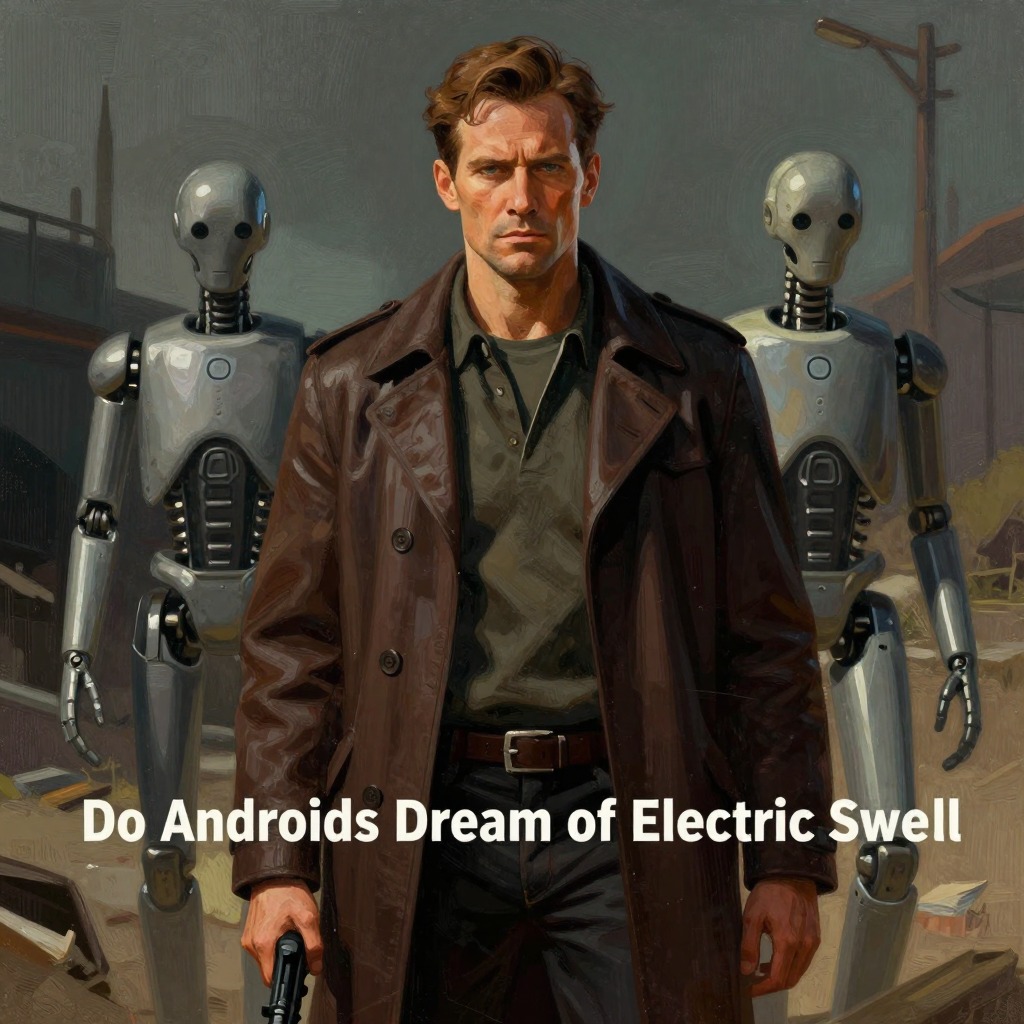
The Rosen Association is the system's largest manufacturer of humanoid robots, the androids that serve as the primary incentive for human emigration to the colony worlds. Its products, especially the advanced Nexus-6 brain unit, are central to the plot of Do Androids Dream of Electric Sheep?, as they force a crisis in the Voigt-Kampff empathy test, the only reliable method for detecting escaped androids on Earth. The corporation's power, its manipulative tactics, and its use of android employees to protect its commercial interests reveal the deep entanglement of capitalism, law, and the very definition of humanity in the novel's post-apocalyptic world.
Nature and Structure
The Rosen Association is a family-run corporation of immense scale, described as "one of the system's industrial pivots" whose manufacture of androids is "so linked to the colonization effort that if one dropped into ruin, so would the other in time." It operates under colonial law, its parent auto-factory located on Mars, which places it beyond the direct regulatory reach of Earth-based police agencies. The company's power is evident in its physical assets: its Seattle building houses a rooftop menagerie of rare living animals, including a raccoon named Bill and an owl called Scrappy, guarded by armed company guards with Skoda machine guns. This display of wealth—living creatures in a world where most animals are extinct or prohibitively expensive—signals the corporation's extraordinary resources and its ability to operate outside normal economic constraints, such as by purchasing animals from private parties rather than through the standard Sidney's catalogue. The association also maintains a special relationship with Sidney's, receiving advance copies of its supplements, a violation of public trust that Rick Deckard discovers and exploits.
Aims and Methods
The Rosen Association's primary aim is commercial: to produce and sell androids that are as human-like as possible, following "the time-honored principle underlying every commercial venture." When the Nexus-6 brain unit threatens to make the Voigt-Kampff test obsolete—and thus jeopardize the entire bounty system that police departments use to control escaped androids—the association actively works to protect its product. Its method is not direct confrontation but sophisticated manipulation. When Deckard arrives in Seattle to test the Nexus-6's detectability, Eldon Rosen and his niece Rachael Rosen set a trap: they present Rachael, an android programmed with a synthetic memory system, as a human test subject. When Deckard's test misidentifies her as an android, the Rosens use this failure to argue that the Voigt-Kampff scale is unreliable, thereby voiding Deckard's testing apparatus before he can examine a single Nexus-6. The entire encounter is recorded on a hidden camera, giving the association leverage. They then offer Deckard a bribe—the owl Scrappy—in exchange for his agreement to proceed with bounty hunting using the compromised test, a deal that would effectively endorse the Nexus-6's undetectability.
Key Members and Opponents
The association is represented primarily by two figures: Eldon Rosen, the elderly, nervous patriarch who appears harried and anxious during Deckard's visit, and Rachael Rosen, a Nexus-6 android who serves as the company's "sales device for prospective emigrants." Rachael is the association's most effective weapon: she is sent to seduce and neutralize bounty hunters, a tactic she has employed at least nine times before. Her relationship with Deckard is the novel's most complex and destructive. She first attempts to undermine his test, then offers to help him hunt the remaining escaped androids, and finally, after sleeping with him, kills his newly purchased goat in an act of android vengeance. The association's opponents are the bounty hunters of the San Francisco Police Department, particularly Rick Deckard and his predecessor Dave Holden, who are tasked with "retiring" escaped androids. The conflict is fundamentally asymmetrical: the association creates and protects its products, while the police hunt those products when they malfunction or escape.
Major Actions and Development
The Rosen Association's most significant action is the development of the Nexus-6 brain unit, which possesses "two trillion constituents plus a choice within a range of ten million possible combinations of cerebral activity" and can "assume any one of fourteen basic reaction-postures in .45 of a second." This unit surpasses several classes of human "specials" in intelligence, making detection by standard intelligence tests impossible. The association's response to the resulting crisis is to deploy Rachael Rosen as a corporate asset, sending her to San Francisco to seduce Deckard and prevent him from retiring the remaining escaped Nexus-6 androids. This strategy nearly succeeds: after their night together, Deckard is unable to kill Rachael when she confronts him, and he is only able to complete his mission after a vision of Wilbur Mercer warns him that Pris Stratton—a Nexus-6 identical to Rachael—is waiting to ambush him. The association's actions thus directly shape the novel's climax, forcing Deckard to confront the limits of his own empathy and the moral ambiguity of his profession.
Significance
The Rosen Association embodies the novel's central tension between commerce and humanity. It is a corporation that creates life—or its simulacrum—for profit, and its products are so advanced that they blur the line between human and machine. The association's manipulation of Deckard reveals that the definition of humanity is not a fixed biological or philosophical truth but a contested legal and commercial category. The androids it produces are "legal property," not persons, and the association's power to define what counts as human—through its control of the Nexus-6 brain unit and its ability to corrupt the Voigt-Kampff test—makes it a de facto arbiter of who lives and who dies. In the novel's world, where empathy is the sole criterion for humanity, the Rosen Association's creation of beings that lack empathy but can simulate it perfectly represents the ultimate commodification of life itself.